
Types and Stages of Pancreatic Cancer
Cancer is a devastating diagnosis affecting millions worldwide; pancreatic cancer is no exception. In recent years, there has been an increasing need to understand the types and stages of pancreatic cancer to guide effective treatment strategies. By categorising pancreatic cancer into different types and stages, doctors can tailor treatment approaches to each patient’s unique circumstances.
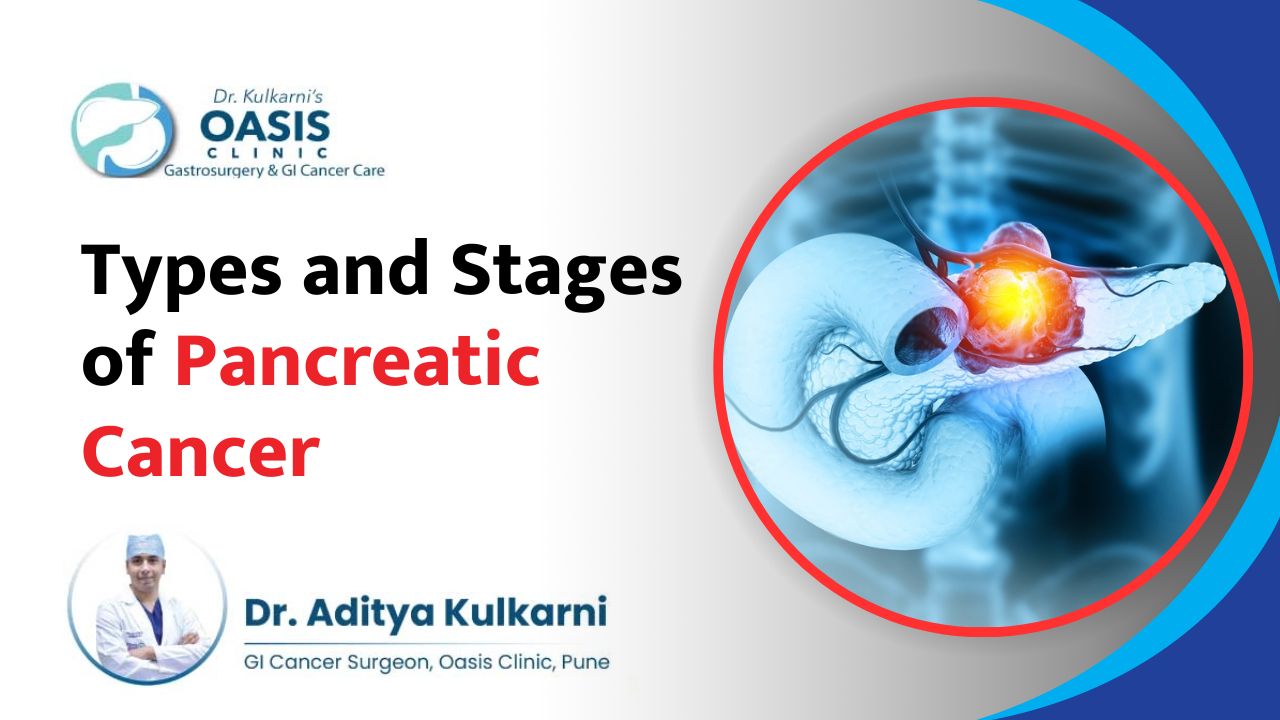
In this all-encompassing guide, we embark on a journey to unravel the Complexities of Pancreatic Cancer , from its diverse classification into types to the critical staging that defines its severity.
Our mission is to empower patients in India with the knowledge essential for informed decisions about their treatment choices, all while extending unwavering support and empathy throughout their courageous journey. Join hands with Dr. Aditya Kulkarni at Oasis Clinic, your trusted Pancreatic Cancer surgeon in Pune, for expert guidance and compassionate care.
Types of Pancreatic Cancer
Understanding the Basics Pancreatic cancer can be broadly categorised into two main types: exocrine pancreatic cancer and endocrine Pancreatic Cancer. Exocrine pancreatic cancer, specifically adenocarcinoma, is the most common type, accounting for approximately 95% of all cases.
Endocrine pancreatic cancer is a neuroendocrine tumour arising from the pancreas’ hormone-producing cells. These tumours can be functional (producing hormones) or non-functional (not producing hormones). It is essential to differentiate between these types as they have distinct characteristics and treatment considerations.
Exocrine Pancreatic cancer, particularly adenocarcinoma, arises from the cells lining the ducts of the pancreas. These cells produce digestive enzymes that help break down food. Adenocarcinoma proliferates, often spreading to nearby organs or lymph nodes. It is typically diagnosed at an advanced stage due to the lack of early symptoms.
Endocrine Pancreatic cancer, also known as islet cell tumours or neuroendocrine tumours, originates from the pancreas’ hormone-producing cells (islet cells). These tumours can produce hormones, such as insulin, glucagon, and gastrin, leading to specific symptoms. Endocrine pancreatic cancer is relatively rare, comprising only about 5% of all pancreatic cancer cases. It tends to grow slower than exocrine pancreatic cancer and has a better prognosis.
Determining the Extent of the Disease Staging Pancreatic Cancer is crucial for determining the extent of the disease and guiding treatment decisions. The staging system commonly used for pancreatic cancer is the TNM system, which stands for Tumor, Node, and Metastasis. This system assesses the size and location of the primary tumour (T), whether cancer has spread to nearby lymph nodes (N), and if it has metastasised (spread) to other parts of the body (M).
The stages range from 0 to IV, with stage 0 indicating carcinoma in situ, where abnormal cells are only found in the lining of the pancreas ducts. Stage IV represents advanced disease with distant metastases, meaning the cancer has spread to distant organs or tissues.
Each stage corresponds to specific criteria, including tumour size, lymph node involvement, and the presence of metastases. By understanding the staging process, patients can gain insights into their prognosis and the appropriate treatment options by understanding the staging process.

The Intent Behind Categorizing Types and Staging
Categorizing Pancreatic Cancer Into types and Stages Serves a vital purpose for patients and surgeons. Understanding the intent behind these classifications empowers patients to participate in their treatment decisions actively. By knowing the type of pancreatic cancer they have, patients can comprehend the specific characteristics of their tumour and the recommended treatment approaches.
Additionally, staging provides valuable information about the extent of the disease, enabling doctors to determine if surgery is a viable option or if alternative treatments, such as chemotherapy or radiation therapy, are more suitable.
The classification of pancreatic cancer into different types allows Doctors to tailor Treatment plans based on the Tumour’s Characteristics. For Example, exocrine pancreatic cancer, specifically adenocarcinoma, is often treated with surgery, chemotherapy, or both. On the other hand, endocrine pancreatic cancer may require a different treatment approach, such as surgery to remove the tumour or hormone therapy to control the production of hormones.
Treatment Approaches Based on Types and Stages
Treatment Plans for Pancreatic Cancer vary depending on the type and stage of the disease. For early-stage pancreatic cancer, surgical options may be considered. The Whipple procedure, also known as Pancreatoduodenectomy, is a complex surgery that involves removing a portion of the pancreas, the Gallbladder, part of the small intestine, and sometimes parts of the stomach and bile ducts. This procedure aims to remove the tumour and surrounding affected tissues.
Chemotherapy is another common treatment approach for pancreatic cancer. It can be used as adjuvant therapy, given after surgery to kill any remaining cancer cells, or neoadjuvant therapy, administered before surgery, to shrink the tumour and make it easier to remove. Chemotherapy drugs target and destroy rapidly dividing cancer cells throughout the body.

For advanced stages of pancreatic cancer, where surgery may not be an option, palliative care becomes a crucial aspect of treatment. Palliative care focuses on managing symptoms and improving the patient’s quality of life. It can involve pain management, nutritional and emotional support for the patient and their loved ones.
In recent years, there have been advancements in targeted therapies for pancreatic cancer. These therapies specifically target cancer cells while sparing healthy cells, reducing side effects.
Targeted therapies block specific signalling pathways involved in the growth and spread of cancer cells. Immunotherapy, which harnesses the immune system’s power to fight cancer, is also being explored as a potential treatment option for Pancreatic Cancer.
Wrapping up
Empowering Patients with Knowledge While a diagnosis of Pancreatic Cancer can be overwhelming, understanding the types and stages of the disease can give patients in India a sense of empowerment and help them make informed decisions about their treatment journey. By knowing the characteristics of their tumour and the stage of their cancer, patients can actively engage in discussions with their surgeons to determine the most suitable treatment options.
Patients must remember they are not alone in their battle against pancreatic cancer. Support groups, online communities, and counselling services are available to provide emotional support, share experiences, and offer guidance throughout the treatment process. Additionally, staying informed about the latest research and advancements in pancreatic cancer treatment can help patients stay hopeful about their prognosis.
Ultimately, by understanding the types and stages of pancreatic cancer, patients can confidently navigate their treatment journey, seek appropriate support, and strive for the best possible outcome in their fight against this challenging disease.

Dr. Aditya Kulkarni
MS, DNB, FRCS, MCh (Surgical Gastroenterology & GI Oncology)
Dr. Aditya Kulkarni is a Consultant of Laparoscopic and Robotic Gastrointestinal, Hepato-biliary-pancreatic, and Cancer Surgeon at the Renowned Oasis Surgery Clinic Pune.
Book An Appointment